e-VLBI Tests
The EXPReS project formally ended in August 2009, but you can get e-VLBI updates from the EVN e-VLBI page and the NEXPReS project web site. Live status reports for both e-VLBI and traditional VLBI runs are available at the JIVE Operations page.Upoming e-VLBI test dates:
- 19 November 2009
- 1 December 2009
- 10 December 2009
- 27 January 2010
- 10 February 2010
- 30 March 2010
- 22 April 2010
- 18 May 2010
Results from past tests:
- 18 May 2006
- 21 August 2006
- 26 October 2006
- 14 December 2006
- 29 January 2007
- 20 February 2007
- 5 March 2007
- 28 March 2007
- 22 May 2007
- 25 June 2007
- 21 August 2007
- 28 August 2007
- 6 September 2007
- 8 October 2007
- 9 October 2007
- 15 November 2007
- 11 December 2007
- 21 January 2008
- 24 January 2008
- 5 February 2008
- 14 February 2008
- 8 April 2008
- 5 May 2008
- 9 May 2008
- 20 May 2008
- 22 May 2008
- 24 June 2008
- 7 July 2008
- 22 July 2008
- 28 August 2008
- 9 September 2008
- 30 September 2008
- 10 October 2008
- 6 November 2008
- 13 November 2008
- 19 November 2008
- 4 December 2008
- 22 January 2009
- 10 February 2009
- 24 March 2009
- 21 April 2009
- 12 May 2009
- 19 May 2009
- 23 May and 10 June 2009
- 5 August 2009
- 27 August 2009
- 10 September 2009
- 29 September 2009
- 15 October 2009
- 21 October 2009
18 May 2006
On 18 May 2006 we achieved the first six station fringes at 256 Mbps with Cambridge, Jodrell Bank, Medicina, Onsala, Torun, and Westerbork. There were first ever European 512 Mbps e-VLBI fringes on the Jodrell Bank - Westerbork baseline. The datarate was too low for Arecibo to get fringes even at 32 Mbps. We tested remote restart of Mark5As at the telescopes. After the test, there was a 13-hours science project at 128 Mbps. This went without major problems.
Return to top of page.
21 August 2006
Cambridge, Medicina, Onsala and Westerbork participated in the 21 August 2006 test. The test objective of restarting and rebooting MarkV units was successful, although we found it’s not possible to do this during a run and recover the station without restarting the run. We had the first 512 Mbp fringes (view fringe plots) between three European stations: Cambridge, Onsala and Westerbork. We also got fringes for the first time between Cambridge, Medicina and
Westerbork using Medicina’s new 5 GHz receiver.
Return to top of page.
26 October 2006
The 26 October 2006 test was carried out using a new correlator control computer. Starting up correlation jobs was much faster. Initially there were network problems to Medicina and Torun, but these had been solved by the start of the observations. During the test phase we ran long correlation jobs to see how long we could maintain a data rate of 256 Mbps. Since this worked fine, we decided for the first time to run the science experiments at this data rate as well. There were two projects that targeted the X-ray binary LSI +61.303, and the eclipsing binary system Algol.
Unfortunately, Onsala had to stop observing because of a storm. Due to various Mark5A related problems, we lost a significant amount of observing time during the night (30% and 20% for the two projects, respectively). Moreover, Cambridge stopped producing fringes after a couple of hours, because of a failing power supply unit in the MkIV formatter. The increase from 128 Mbps to 256 Mbps partly compensated for these losses. Both of the targets were nicely detected in the data analysis pipeline.
Return to top of page.
14 December 2006
The 14 December 2006 test went extremely smoothly with three science projects incorporated. Participating stations were Westerbork, Jodrell Bank, Cambridge, Medicina, Onsala and Torun, with a 256 Mbps data rate easily achieved from all stations. During a short period we experienced problems with connections to Torun and Medicina, but these were resolved without losing significant amounts of data. Problems at the correlator were few and quickly corrected, again without losing much time or data.
Return to top of page.
29 January - 1 February 2007
The 29 January 2007 run was set up as a double adaptive run (29 January - 1 February), in which the first run was to be used to select targets for the second run. For this reason it was essential for the data of the first run be reduced as quickly as possible. The usual 6 stations participated: Westerbork, Cambridge, Jodrell Bank, Torun, Onsala and Medicina, at a data rate of 256 Mbps. A few problems were encountered, but at a technical and operational level the observations went extremely well. No serious problems were encountered, and restarts of the correlator and Mark5 units were few.
The reduction strategy also worked well, and pipeline maps were produced for 14 out of 16 sources by the end of the first run. Unfortunately, none of the sources were found to be in an active state and the second run was cancelled. We did, however, reserve four hours of test time with all telescopes on 2 February. During this test, in which we observed a strong calibrator source, we were able to achieve a one hour 512 Mbps run with five stations (excluding Torun) and produce the first map at 512 Mbps.
Return to top of page.
20 February 2007
Torun, Medicina, Onsala, Westerbork, Cambridge and Jodrell Bank (MKII) participated in the 20 February 2007 test. One science proposal to detect potential calibrator sources for future observations was accepted for this session. The session began with general tests, during which a 512 Mbps data rate was again achieved from five out of the six stations. The science observation was then run at 256 Mbps and, excepting for the loss of approximately 30 minutes of data from Medicina due to a Mark5 unit, all went very smoothly. Cambridge, unfortunately, was not able to produce usable data, but this problem was not related to e-VLBI and has since been corrected. None of the four calibrator sources were detected, indicating that they are resolved.
Return to top of page.
5 Mar 2007
The first e-VLBI test at 1.3cm (22 GHz) was conducted on 5 March 2007. The main goal was to produce first fringes to Metsähovi, but the new dual polarization receiver at Onsala was also checked. Other participating telescopes were Cambridge, Jodrell Bank (MKII) and Medicina. The experiment was a great success with fringes to all five telescopes at a 256 Mbps data rate.
This test proved to be very useful to check the telescope performance before the K-band session observations started. This is normally done in the ftp fringe tests, when a small amount of disk-recorded data is transferred from the telescopes to JIVE and analysed by the software correlator. This time the ftp test failed because Effelsberg experienced high winds and the signal-to-noise ratio was very poor. Using e-VLBI to transfer data to the hardware correlator in real-time, however, performance of the remaining telescopes could be checked.
Return to top of page.
28 March 2007
An e-VLBI science run took place on the 28 March 2007 involving Jodrell Bank (MarkII), Cambridge, Onsala, Westerbork, Torun and Medicina at a data rate of 256Mbps. There were some restarts due to problems with station units and the correlator, although these were not directly e-VLBI related, as well as time synchronisation difficulties which will have to be investigated further. This was the first science run in the L-band, and the first to be completely conducted by an operator and a support scientist without the direct supervision of the technical staff, illustrating the increase in robustness and user-friendliness of the system over the past few months.
Return to top of page.
22 May 2007
The e-VLBI test run on 22 May with Cambridge, Jodrell Bank, Medicina, Torun and Westerbork was successful. A new switch/router at JIVE, new IP address space for some stations and upgraded Mark 5As worked flawlessfly.
The connection between Torun and JIVE was unavailable at the beginning of the test but was re-established halfway through. With the connection re-established, it was decided to restart the correlator and Mark 5s for a clean start. The clock search at 256 Mbps was fine, but most stations could not keep up at the 512 Mbps rate. This was likely due to a change in data transfer configuration after the Mark5As were rebooted.
Return to top of page.
25 June 2007
The 25 June 2007 test was the smoothest to date. With participation from Cambridge, Jodrell Bank (MkII), Medicina, Onsala, Torun and Westerbork stations, the run began with a science observation of almost 12 hours at 256 Mbps, including a 2.5 hour stretch with no problems. Following the science portion, the test continued for another four hours at 512 Mbps, again without any faults or failures, a first ever for six-station e-EVN run at 512 Mbps. (See the press release "First 512 Mbps e-EVN image from six stations".)
The connection to Shanghai was also tested operationally for the first time. Although not directly successful, this was a very useful first step towards including Shanghai in science e-VLBI.
Return to top of page.
21 August 2007
The main goal of the 21 August test run was to test the modified UDP Mark5A code and push the data rate as high as possible. Overnight there were science observations, the first spectral line project with e-VLBI. The array was slightly different from the previous runs; the Cambridge telescope was replaced by Darnhall, and a single dish was used in Westerbork instead of the phased array. Because of the low data rate of 32 Mbps, the correlation jobs were remarkable stable. The 8-hour experiment was correlated in two jobs of 5.5 hours and 2.5 hours. There were minor problems with the telescopes, Medicina being too late in some of the fringe-finder scans, and Westerbork showing too high polarization leakage. Otherwise the experiment was a great success.
Return to top of page.
28 August 2007
On 28 August 2007, e-VLBI fringes between Shanghai-Mopra and then Shanghai-western European stations were demonstrated live at the APAN networking conference in Xi'An, China. Additionally, there was a short time of about ten minutes when there were fringes between Mopra and European stations as well, probably the longest VLBI baselines ever achieved at 12,300 km. See the full press release here.
Return to top of page.
6 September 2007
During this run we continued testing the UDP-based Mark5A software. At low data rates there were no problems. However at 512 Mbps we could not get fringes to all telescopes. It is likely that the error occured in our local network, and this is under investigation.
After the test phase there were two science experiments. Because Cambridge was still unavailable, we used again Darnhall. There was only one-way communication with the telescope, and reaching even 256 Mbps was not possible with TCP. We decided to use the UDP-based Mark5A code for Darnhall, which is the first science application of UDP for e-VLBI. Both experiments were successful, and the second one produced the first Astronomer's Telegram report on e-EVN science observations.
Return to top of page.
8 October 2007
The 8 October 2007 test involved real-time science observations with the Parkes, Mopra and ATCA telescopes in Australia, correlated at JIVE. Data were sent from each telescope at 512 Mbps over three dedicated 1 Gbps lightpaths, provided by a collaboration of AARNet, CENIC, CANARIE and SURFnet. Physically the paths led from the observatories to Sydney, across the Pacific to Los Angeles, Seattle, Chicago, Amsterdam and finally to JIVE in the Netherlands. The UDP transport protocol was used with a modified Mark5A control code developed at JIVE. At the Australian end, data acquisition was done on the LBADR VLBI system (a derivation of the PCEVN) with a Mark5A command emulator, and converted on-the-fly to the Mark5B format. The data were received at JIVE on Mark5A+ units. Data transport via the lightpaths was nearly perfect, and 512 Mbps transfer was easily sustained for more than 12 hours.
Return to top of page.
9 October 2007
We targeted the highest data rates yet in the formatter test on 9 October 2007, using two versions of the modified Mark5A software (both UDP-based). There were numerous problems. However near the end of the run, we managed to get data from Torun to JIVE at 1024 Mbps, the highest to date, with 4% packet loss. The data have been successfully synchronised, displaying green LEDs on the correlator Station Units.
Return to top of page.
11 December 2007
On 11 December 2007 we conducted an e-VLBI test during which we, for the first time, obtained real-time fringes from five telescopes at nearly 1 Gbps. The test started with six telescopes at 512 Mbps (Westerbork, Onsala, Torun, Medicina, Jodrell Bank and Cambridge). After making sure the 512 Mbps mode worked without problems, we tried higher bandwidths. Unfortunately, Onsala could not participate, as the motherboard/CPU of the Mark5 at Onsala has not been upgraded. As can be seen in the first plot, good fringes were obtained from all five telescopes. The second plot shows the aggregate data rate into JIVE.
Although we are still some way from advertising this as an operational observing mode, it clearly has a lot of potential. With it we will be able to use available bandwidth nearly to the limit. We are now working on a scheme to avoid dropping headers, which will make it easier for the correlator to keep the data streams synched, and we will investigate the possibility to create a closed loop in which the drop rate is automatically adjusted by the availability of bandwidth.
Return to top of page.
21 January 2008
On 21 January a new script was exercised for downloading and installing the jive-mark5 code, and some problems with Onsala and Medicina (both of which upgraded their Mark5s recently) were solved. After this, 512 Mbps data rate was tested from all stations (Mc, Wb, On, Tr, Cm and Jb2) and found to work reliably. It was followed by a run at 1 Gbps with packet dropping. The fibre links were filled to near-capacity, but the correlator could not keep up due to data headers being discarded with the dropped packets.
Return to top of page.
24 January 2008
On 24 January a new version of the correlator control code was tested. This version, implemented by JIVE, had modifications to the packet dropping algorithm so that only data packets are dropped at the sending side while headers remain intact. There was apparent improvement, with the correlator able to synchronise the data streams immediately while only dropping 4.5% of the packets. Due to telescope constraints there was only one baseline that produced fringes (Torun-Medicina), but the correlation jobs were succesfully run for several hours at 1 Gbps with three stations (Mc, On, Tr). Click here to see aggregate bitrate traffic to the correlator.
Return to top of page.
5 February 2008
On 5 February 2008, Arecibo rejoined e-VLBI operations after a long absence. At this time, connectivity is still limited by a shared 155 Mbps connection to the mainland United States, but this situation is expected to improve very soon. 64 Mbps produced immediate fringes. 128 Mbps was only reached for very short periods, no doubt because of competing traffic. However, by dropping one in five packets at Arecibo, steady green LEDs and good fringes were obtained at an effective transfer rate of approximately 100 Mbps.
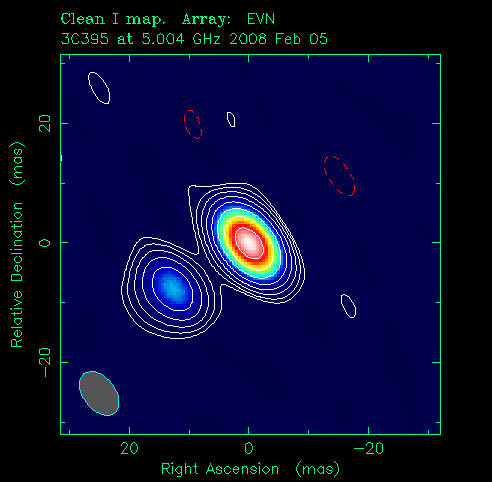
After this success, we observed 3C395 (image) with six stations (Medicina, Westerbork, Onsala, Torun, Cambridge and Jodrell Bank) at approximately 1 Gbps, with only formatter data from Onsala. The Cambridge microwave limits useful transfer to 128 Mbps, but from a correlation point of view, this was a robust 1 Gbps run sustained for several hours.
Return to top of page.
14 February 2008
On 14 February 2008 we conducted the first successful real-time data transfer between the Effelsberg radio telescope and the EVN correlator at JIVE. Formatter data was sent at a modest data rate of 256 Mbps to prevent disturbances to an ongoing geodetic data transfer to the Bonn correlator. The data transfer ran smoothly for about an hour with green LEDs at the EVN correlator for the duration.
We also conducted a separate Mark5B-based e-VLBI test of JIVE Mark5 control code. This code was used to direct the transfer of Mark5B data from Westerbork to a Mark5A+ at JIVE via UDP, at conservative rates of 128Mbps and 256Mbps. There were no green LEDs at the station units, and testing with official Mark5A code indicated an A+ configuration issue. In principle, however, things are looking good for Mark5B-based (B to A+) e-VLBI.
Return to top of page.
8 April 2008
On 8-9 April 2008, the first production 512 Mbps e-EVN observations took place. Participating telescopes were Cambridge, Jodrell Bank, Medicina, Onsala, Torun, and the Westerbork phased array. Two science projects were observed: one normal non-triggered and one triggered.
The correlation job on the first project ran for nearly 13 hours, the longest uninterrupted correlation job at JIVE, including disk operations. The first 45 minutes of the second project were lost because of a control computer problem unrelated to e-VLBI, and another hour of Mc data was lost due to a problem with a Mark5A. In spite of this, the run went very well and we collected about 8.5 hours of data on the X-ray binary Cyg X-3, the preliminary results of which were published in The Astronomer's Telegram #1476.
You can view a plot of the data throughput for both science runs here.
Return to top of page.
5 May 2008 9 May 2008
On 5 May 2008, Hartebeesthoek Radio Astronomy Observatory in South Africa joined the e-EVN. A new connection via Johannesburg and London was quickly tested, and e-VLBI was demonstrated for a delegation of EU officials in Hartebeesthoek. Although the expected bandwidth limit was 50 Mbps, the tests showed that 64 could be sustained, and even 128 Mbps for a very short time. Other participating telescopes for the demonstration were Arecibo, Cambridge, Jodrell Bank, Medicina, Onsala and Torun. A fringe was detected on the Hartebeesthoek-Arecibo baseline for a short time, although these telescopes have very little mutual sky coverage. Remaining time was allocated between sources that could be observed by either Hartebeesthoek or Arecibo with European telescopes.
On 9 May, the first e-VLBI test was carried out with the 6m Transportable Integrated Geodetic Observatory (TIGO) telescope in Chile along with Medicina and the Westerbork phased array telescopes in the X-ban at 32 Mbps. Data were successfully transferred from TIGO, but there were fringes only on the Medicina-Westerbork baseline. After identifying the problem we optimised the schedule for TIGO observations and carried out another test in the evening with TIGO and Arecibo. This resulted in first light fringes to TIGO at 32 and 64 Mbps.
Return to top of page.
20 May 2008
On 20 May 2208 we tested inclusion of telescopes with slow connectivity in high data rate experiments. This was done between European telescopes and Arecibo with connectivity limited to 150 Mbps. The schedule included data rate modes from 128 to 1024 Mbps.
The next day there was a science experiment observed, the first science run that included the Effelsberg telescope. The observations were carried out in the C-band at a data rate of 512 Mbps.
Return to top of page.
22 May 2008
On 22 May 2008, as part of a live e-VLBI demonstration at the TERENA Networking Conference 2008 in Bruges, Belgium, we simultaneously linked telescopes for the first time ever in Africa, Europe, North America and South America to the central data correlator in the Netherlands, simulating a telescope almost 11,000 kilometers in diameter. See the science/astronomy- and the
networking-specific press releases.
Return to top of page.
24 June 2008
On 24-25 June 2008 we observed three short projects during an e-EVN run. The observations went very well. One of the experiments targeted a radio source that is a possible counterpart to the variable gamma-ray source recently detected by AGILE in the Cygnus region. The e-EVN data show a compact component which may be partially resolved. This result was published in The Astronomer's Telegram #1597.
Return to top of page.
7 July 2008
On 7 July 2008, a test was conducted using formatted data transferred from Westerbork to JIVE at 1024 Mbps without packet loss. Because 1024 Mbps does not fit in a 1 Gbps ethernet connection, the Linux "ethernet bonding" driver was used to create a virtual network interface that consists of two 1 Gbps ethernet cards.
Traffic sent to this virtual interface was transmitted over both physical interfaces in a round-robin fashion so that even at 1024Mbps, each physical interface only transmits 512Mbps of the traffic.
The 34.4 km dark fiber between Westerbork and JIVE was recently upgraded to use multiple wavelengths (CWDM), with each wavelength able to carry 1 Gbps. Two of these wavelengths were used to bring both 1 Gbps ethernet links to JIVE. There they were fed to the central switch/router, which was connected through a 10 Gbps ethernet link to a Mark5A.
Return to top of page.
22 July 2008
On 22 July 2008, JIVE and the Multi-Element Radio Linked Interferometer Network (MERLIN, operated by Jodrell Bank Observatory) conducted an experiment to increase the number of MERLIN stations that can be used simultaneously for e-VLBI. By connecting the microwave links from the telescopes at Darnhall and Cambridge both to the VLBA rack in Jodrell Bank, and choosing a suitable LO frequency and track mapping scheme, data could be sent from both telescopes to the same Mark5A at Jb and from there to JIVE.
To achieve this, the "mirroring" functionality of the JIVE switch/router was used. This instructs the switch to copy any network packet it delivers to a particular port also to a "mirror" or monitoring port. An alternative implementation that uses IP multicasting to achieve the same duplication without having to reconfigure parts of our network is under investigation as well.
Return to top of page.
28 August 2008
On 28 August 2008, we succeeded in dynamically switching between sources during an e-VLBI run. The switch was made at Torun and Westerbork (in single dish mode) with Jodrell remaining on the first source. Fringes were obtained to all three telescopes before, and again between Tr and Wb after the switch.
This first attempt at EVN dynamic scheduling shows that in principle on-the-fly schedule changes are feasible, with the caveat that the observing setup remains the same.
Return to top of page.
9 September 2008
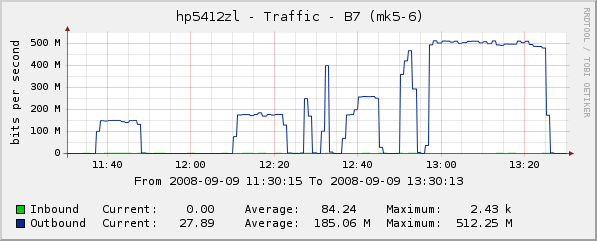
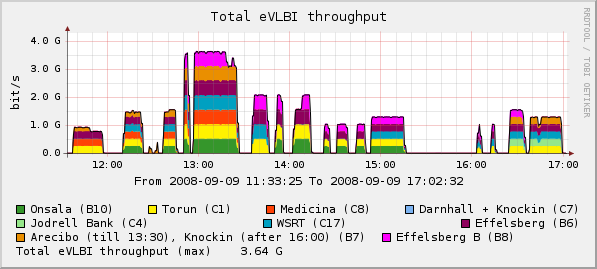
On 9 September 2008, we were able to demonstrate real-time fringes between Arecibo and several European EVN telescopes at a rate of 512Mb/s. This was made possible because of improvements in the network connectivity from Puerto Rico to the mainland USA via the PRISANET gigabit infrastructure jointly developed by the Univerisity of Puerto Rico, Centennial and the AO, and a dedicated network path all the way from Arecibo to JIVE. Images of the networking throughput (Arecibo, total) and fringes (Arecibo) from this test are available.

Return to top of page.
30 September 2008
On 30 September 2008, a short science project was observed in the L-band at 512 Mbps. The results were used by the astronomers to propose full-track VLBI observations of the target. The pipeline data were delivered in time for the proposal deadline on 1 October.
Return to top of page.
10 October 2008
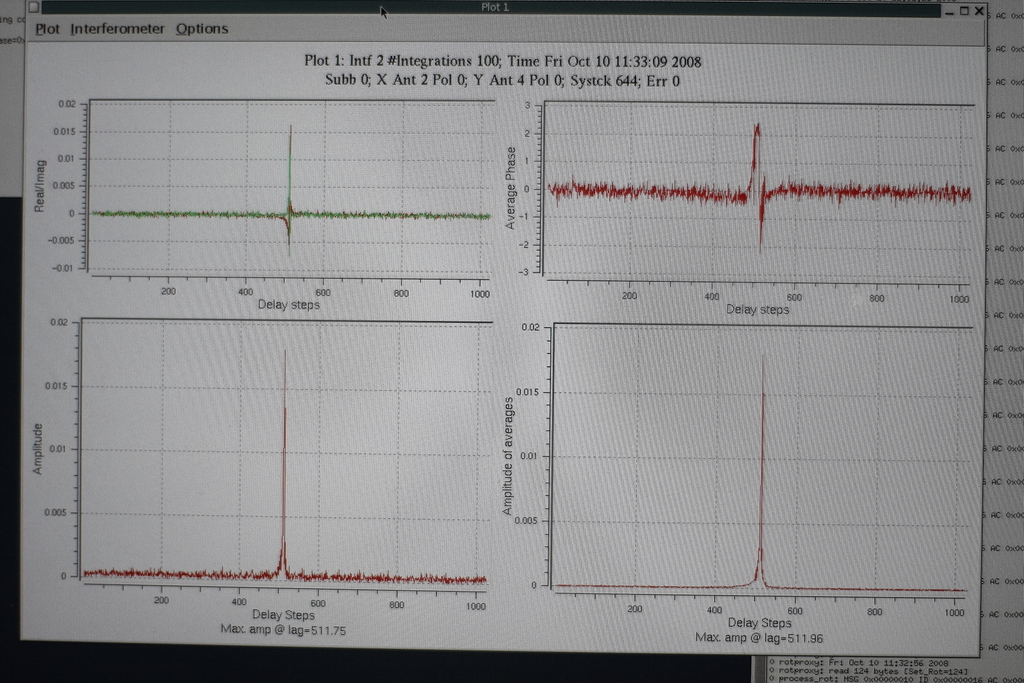
On 10 October 2008, we conducted an e-VLBI test with Westerbork's Mark5A and Mark5B and found fringes. The Mark5A was attached to a single dish, and the remaining telescopes were fed to the Mark5B via the new digital Tied Array unit TADUmax. The telescopes were observing 4C39.25 at 5GHz. These were the first e-VLBI fringes with the Mark5B and the first e-VLBI fringes with TADUmax in Westerbork.
Return to top of page.
6 November 2008
On 6 November 2008, we observed an e-EVN Target of Opportunity (ToO) project with Jb2, Mc, On, Tr and Cm participating. In the first 1.5 hours there were fringe-finders scheduled for data checking and clock-searching. For the first time, we did this in an automated fashion, without interrupting the correlation job. This makes the preparation time for e-VLBI observations shorter. Although we had initial problems with two Mark5As at JIVE, observations of the target source started as planned. The rest of the run went very smoothly, except for a few minutes "diagonal weight" in one of our station units.
The PI was able to begin analysing data the following day, and Astronomer's Telegram #1836, including a preliminary e-VLBI map, was published two days later. Additional e-VLBI observations are planned.
Return to top of page.
13 November 2008
On 13 November 2008, the full array was available, this time including Ef, Wb, and Ar. Shanghai successfully participated in the initial fringe test part of the experiment. The data rate was 512 Mbps, except for Arecibo which was limited to 128 Mbps. This was the first e-VLBI experiment in which the telescopes in Westerbork were remotely operated from Dwingeloo. More importantly, the new digital backend system (TADUmax) and a Mark5B were used in Westerbork for the observations.
In addition to the usual e-EVN array, a third MERLIN telescope participated in the experiment as well. Data from Knockin was streamed through the VLBA rack in IFs not in use by Cambridge, and ended up on tracks on the same Mark5A as used by Cambridge. The resulting datastream was then sent to JIVE as a Multicast datastream. Each receiving Mark5A at JIVE that is responsible for handling the data from one of the MERLIN telescopes can subscribe to this stream, which is only sent across once from Jodrell Bank to JIVE. This was the first time we used this new feature in a science observation, the second epoch observation of galactic radio-jet source SS433.
Return to top of page.
19 November 2008
On 19 November 2008, the third epoch observation of SS433 was observed in a similar fashion to the second epoch (13 November). However, an additional important milestone was achieved; three of the e-EVN telescopes, Effelsberg, Onsala and Westerbork observed and sent data at a full 1024 Mbps during the whole run, without dropping data packets. We are working on including more telescopes at a full 1024 Mbps in the near future.
This observation was also demonstrated live to attendees of the Effelsberg-Bonn Fibre Inauguration in Effelsberg, Germany.
Return to top of page.
4 December 2008
In December 2008 there were a number of tests including stations in Asia and Australia in preparation for the e-VLBI demonstrations at the opening of the International Year of Astronomy 2009. The participating stations were ATCA, Mopra, Hobart, Kashima, Sheshan, Urumqi, all at 256 Mbps, except for Hobart, which took part at 128 Mbps. These tests produced the first realtime fringe for Urumqi, Hobart, and Kashima. The data at Kashima were dynamically translated from K5 to Mark5B format.
Return to top of page.
22 January 2009
On 22 January 2009, there were three science projects observed at 18 cm. Shanghai participated along with the regular western e-EVN telescopes. In one of the projects that required very high sensitivity, the Lovell Telescope replaced the MarkII in Jodrell Bank. This was the first e-VLBI use of the LT.
Return to top of page.
10 February 2009
On 10-11 February 2009, two science projects were observed in the L-band at 512 Mbps.
The first observation included Arecibo (at 256 Mbps) and most western EVN telescopes, including Lovell, Cambridge and Knockin telescopes from MERLIN. Effelsberg did not participate, due to a crack in the azimuth rail, and the Lovell Telescope also stopped after the first hour because a crack was discovered in the azimuth rail there, too. As usual for L-band, some RFI caused minor problems, but otherwise the observations went well.
Shanghai and the MarkII telescope at Jodrell joined the second observation. There were no major problems until the final 30 minutes when a restart of the Cambridge Mark5A was required. The restart went well, but we could not get back Knockin and also had problems with Onsala. A correlation job restart was necessary, but failed in the last 20 minutes. Overall, however, this second observation was also a great success.
Return to top of page.
24 March 2009
On 24-25 March 2009, we had an e-VLBI run at 5 GHz with Cambridge, Effelsberg, Jodrell Bank (MkII), Knockin, Medicina, Onsala, Torun and Westerbork. There
were two science projects: a regular proposal and a triggered proposal.
There were problems at some stations due to weather, as well as technical problems which will be discussed at the upcoming Technical Operations Group. We were, however, able to transfer a full 1024 Mbps data from Effelsberg, Onsala, Torun and Westerbork. FITS files and pipeline results were distributed to the PIs, who will surely be satisfied with the data in spite of the problems mentioned above. The pipeline analysis in particular showed good data for all telescopes that observed at 1024 Mbps.
Click here for a plot of the total data throughput.
Return to top of page.
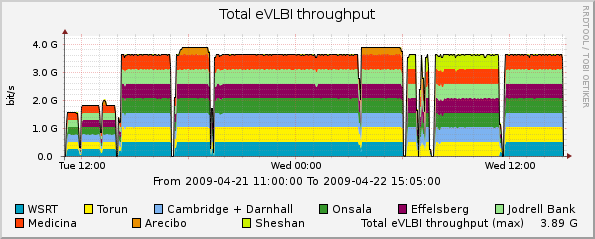
21 April 2009
The e-EVN run on 21-22 April was very busy. Two regular
projects, a short request, and a ToO were observed. This run was done
at 1.6 GHz at 512 Mbps with Effelsberg, Medicina, Onsala,
Torun, Westerbork, Shanghai, Cambridge, Jodrell Bank (Lovell), Darnhall,
and Arecibo participating. Westerbork could not take part in the
ToO observations because the source was out of the HA limit in that
UT range. Arecibo was available only for the two regular projects:
there were initial connection problems, but these were eventually
solved by rerouting to the regular network.
Click here for a plot of the total data throughput.
Return to top of page.
12 May 2009
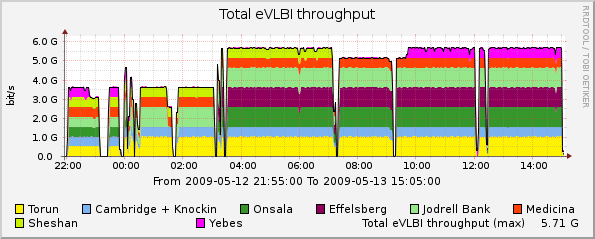
On 12-13 May 2009, several EVN telescopes took part in a
Target of Opportunity observation of Cyg X-2, including Torun,
Cambridge, Knockin, Onsala, Jodrell Bank, Medicina, Sheshan,
and Yebes. Apart from a larger-than-expected clock offset at
Yebes, the observation went extremely smoothly. This was
the first time that Jodrell Bank participated at a full
1024Mbps.
After the science run, several stations tested a Domino implementation for e-VLBI with a Mark-5B. In this test, we detected real-time fringes for the first time from a Mark-5B equipped station (Yebes) connected to a Mark-5B at JIVE. Unfortunately, the Mark-5B IO board stops completely as soon as a single corrupted header frame is received. We are investigating work-arounds for this issue to make this mode more robust.
Click here for the total e-VLBI throughput graph.
Return to top of page.
19 May 2009
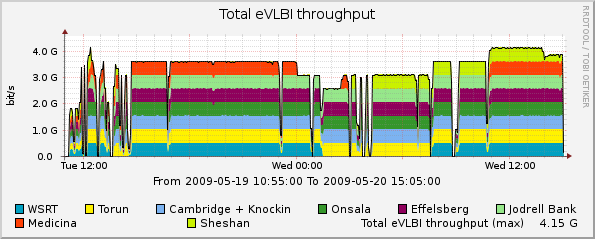
On 19-20 May we did the second epoch of a ToO project, and two
other regular observations. The array configuration and observing
setup were similar to the 21 April run, except that Arecibo was
not included and Darnhall was replaced by Knockin in MERLIN. Medicina was
lost overnight because the lightpath went down. It was only fixed
a few hours before the end. One of the projects was badly affected
by a 10-minutes BOCF jump (wrong timecode assigned to the data) in
the correlator. The data were corrected afterwards. The loophole
allowing this to happen was closed.
Click here for an aggregate graph of e-VLBI data streams from all participating stations.
Return to top of page.
23 May and 10 June 2009
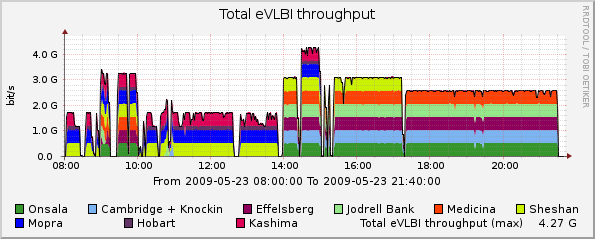
On 23 May and 10 June we carried out two epochs of our first ToO
observations that requested a truly global e-VLBI array. Moreover,
this was the first science project to be observed in the K band
(22 GHz). The participating EVN telescopes were Cambridge, Jodrell
Bank (MarkII), Effelsberg, Medicina, Onsala, Metsähovi (epoch 2),
Yebes (epoch 2) and Shanghai. Kashima joined from Japan, and Mopra and Hobart
joined from Australia.
We faced a number of challenges in these two runs. There were three telescopes that do not regularly participate in e-VLBI observations (although they have participated in tests and demos), and the high frequency combined with the very long baselines complicated clock searching. Eventually all worked out well, and we produced our longest e-VLBI baselines ever in units of observing wavelengths.
Kashima data synchronisation was greatly improved by the second epoch, but there are still issues to be resolved. No fringes were found to Kashima as yet. Hobart initially had a setup problem, which was solved before the end of the first experiment. An additional run is planned with more Australian telescopes.
See network graph for the first epoch.
Return to top of page.
5 August 2009
On 5 August the first fringes to the new Miyun 50m radio telescope
were detected with the JIVE software correlator. See the web: http://www.evlbi.org/tog/ftp_fringes/EY008A/index.html.
EY008A was a small VLBI experiment, proposed to test the EVN's compatibility with China's new Miyun 50m and Kunming 40m radio telescopes, and to study five bright GHz-peaked-spectrum radio sources. The other participating stations were Onsala, Medicina, Urumqi, and Sheshan.
The Miyun telescope is located in the small town of Bulaotun, approximately 140 km from downtown Beijing. Due to its location, the EVN u-v coverage is improved considerably with addition of this telescope.
Return to top of page.
21 October 2009
On 21 October we had an e-VLBI test with Badary (Quasar Network,
Russia)
at 32 Mbps. The other participating stations were Jodrell Bank,
Onsala and Torun. Initially we had a problem with the Station Unit
that received Badary data. When we switched to another SU, we had
good data almost immediately.
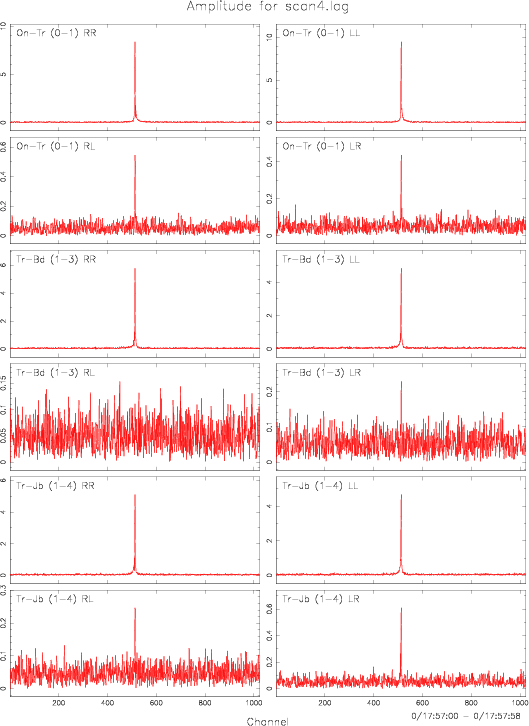
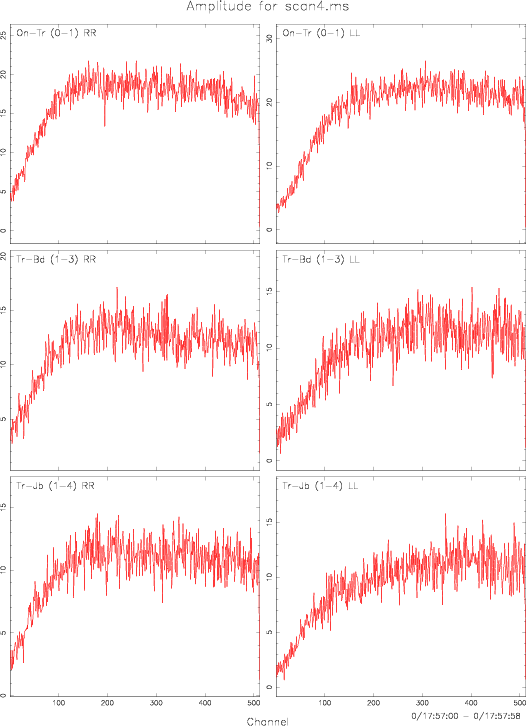
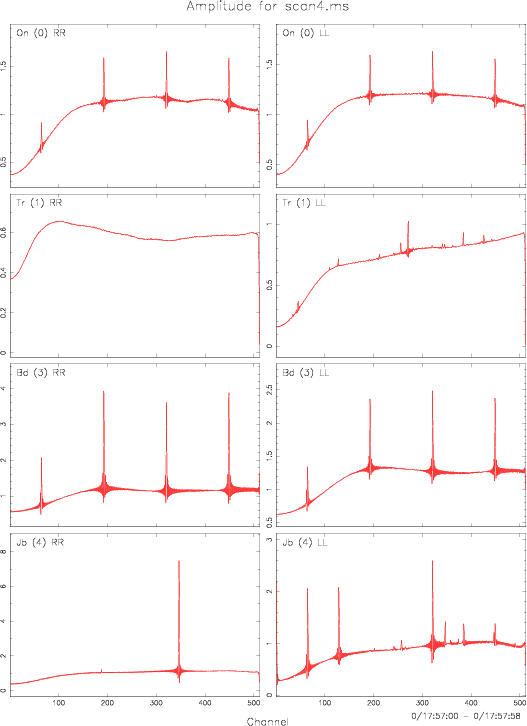
There were fringes to all participating stations. The Badary clock was close to the expected value (within a few microseconds).
Lag domain fringe plots, frequency domain cross-correlation plots (all used Torun as reference antenna) and plots of the autocorrelations are available.
Return to top of page.